
Context
The Batagaika crater situated in Russia, is the world’s largest one kilometre-long permafrost crater, is expanding at a baffling rate due to the thawing of the permafrost. This has been exacerbated by global warming. What is Permafrost?- Permafrost is any ground that remains completely frozen — 32°F (0°C) or colder — for at least two years
- Permafrost is most common in regions with high mountains and in Earth’s higher latitudes — near the North and South Poles.
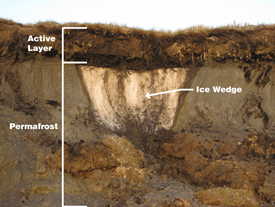
- Permafrost is made of a combination of soil, rocks and sand that are held together by ice. The soil and ice in permafrost stay frozen all year long.
- Near the surface, permafrost soils also contain large quantities of organic carbon—a material leftover from dead plants that couldn’t decompose, or rot away, due to the cold.
- Lower permafrost layers contain soils made mostly of minerals.
- *A layer of soil on top of permafrost does not stay frozen all year.
- *This layer, called the active layer, thaws during the warm summer months and freezes again in the fall.
| In colder regions, the ground rarely thaws—even in the summer. There, the active layer is very thin—only 4 to 6 inches (10 to 15 centimeters). In warmer permafrost regions, the active layer can be several meters thick. |
- As Earth’s climate warms, the permafrost is thawing. That means the ice inside the permafrost melts, leaving behind water and soil.
- Thawing permafrost can have dramatic impacts on our planet and the things living on it.
- The crater is located in the Sakha Republic of Russia and reaches depths of up to 100 metres.
- In the 1960s, after deforestation led to the melting of the underground permafrost, it caused the land to sink.
- Over the years, the crater has only expanded and is locally called ‘the cave-in’ or ‘mega-slump’ by scientists.
- Russia is warming about 5 times faster than the rest of the world. As a consequence, the long-frozen tundra that covers 65 per cent of the country’s landmass is melting.
- The soil beneath the slump contains dangerous amounts of organic carbon that will be released into the atmosphere as the permafrost thaws, further fuelling the planet’s warming.
- This is releasing greenhouse gasses like methane stored in the thawed soil which is 25 times more potent than carbon dioxide.
- The thawing permafrost causes very tangible, immediate infrastructural damage as well such as buckling roadways, splitting houses, and disrupting pipelines.
Do you know?
|